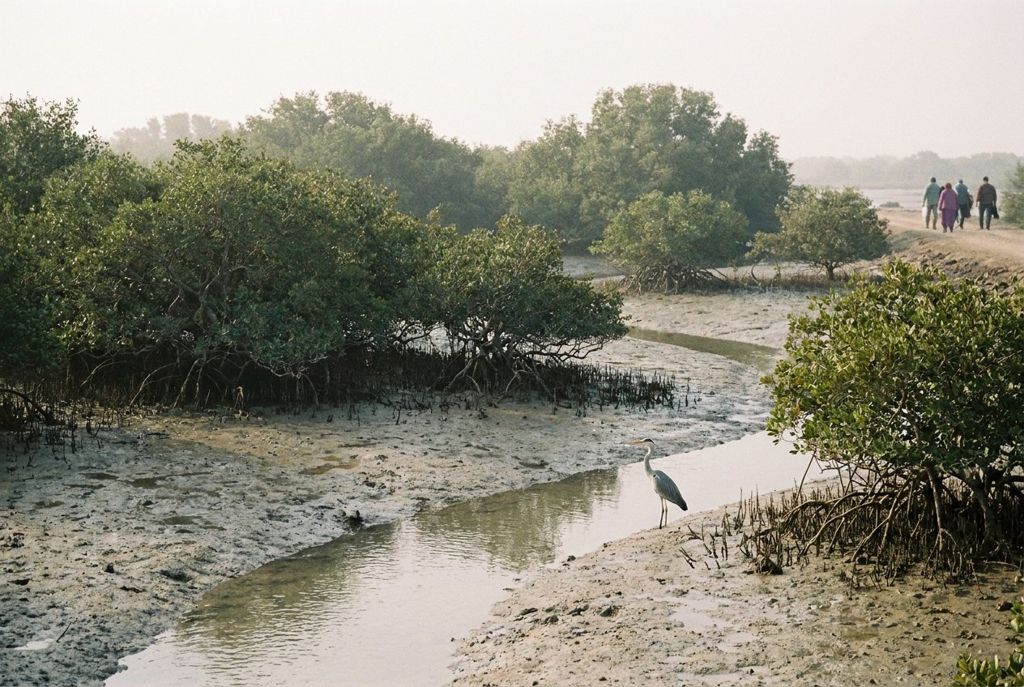
On the northern edge of Ajman, a sheltered lagoon of grey mangroves gives the coast back some of its original green, with wading birds, small fish and calm water.
Al Zorah lies on the northern side of Ajman, where a shallow lagoon opens to the Gulf between low sandy shores. Much of the lagoon is lined with mangroves, and an area of it is protected as a nature reserve. Around it, new roads and buildings have gone up, but the water and its trees remain a place where the coast still looks much as it did before the cities spread along it.
It is a small area by the standards of the large mangrove parks in Abu Dhabi, and you should not expect a wilderness. Come for an early morning of slow paddling or birdwatching, and it rewards you well.
What the mangroves are
The trees here are grey mangroves, the only mangrove species that grows naturally in the UAE. They tolerate salt water, high temperatures and soft, oxygen-poor mud, and they send up a thicket of pencil-like breathing roots around each tree. At low tide, these roots stand in rows across the mud; at high tide, they disappear under the water and the trees seem to float.
Mangroves matter well beyond their size. They shelter young fish, crabs and shrimp, protect the shore from erosion, filter the water and store carbon in their mud. The UAE has planted and protected mangroves along much of its coast, and areas like Al Zorah are part of that effort.
Birds of the lagoon
Birds are the main draw for many visitors. Greater flamingos are often present in the cooler months, feeding in the shallows with their heads upside down. Herons and egrets of several kinds stand motionless along the channels, waiting for fish. Kingfishers, waders and gulls are common, and in the migration seasons the lagoon becomes a stopping point for birds travelling between Asia and Africa.
Binoculars make a big difference. Flamingos in particular keep their distance, and approaching them too closely, whether on foot or by boat, makes them move off. Watch from the water's edge or from a kayak drifting quietly, and let the birds stay where they are.
Beneath the surface, the lagoon is busy too. Small fish dart between the roots, and fiddler crabs wave one oversized claw from the mud at low tide. Mudskippers, fish that spend much of their time out of the water, sometimes skip across the exposed banks. Sit still for a few minutes at the edge of a channel and the life of the place starts to show itself.
Another note: The Ajman corniche at sunset
Kayaking in general
Paddling is the most common way to explore the lagoon. Rental kayaks and guided paddles are usually available nearby, especially in the cooler months. The channels between the trees are sheltered and calm, which makes them suitable for beginners, but a few points help.
- Check the tide. At low water, some channels become too shallow to paddle and you may end up dragging the boat through mud.
- Wear a buoyancy aid and keep your phone in a dry bag.
- Stay in the open channels and do not push into the trees; branches and roots damage easily.
- Do not step on the mud. It is soft and deep in places, and it is home to crabs and other creatures you would crush.
- Keep well away from feeding or resting birds.
Heat, sun and timing
On the water, there is almost no shade, and reflected light from the lagoon adds to the strength of the sun. From late spring to early autumn, the only comfortable time to be out is the first couple of hours after sunrise. Even in winter, a midday paddle can leave you sunburnt and dehydrated, and the glare off the water tires the eyes faster than you expect. Polarised sunglasses help you see into the channels as well as cutting the glare. Wear a hat, long sleeves of a light fabric and sunscreen, and drink before you feel thirsty.
The early morning is also the best time for birds and for still water. By mid-morning, a breeze often gets up, the light flattens and more boats arrive.
Respecting a protected area
Parts of Al Zorah are protected, and the rules are simple: leave nothing behind, take nothing away, keep noise down and keep your distance from wildlife. Do not feed birds or fish, and do not collect shells, plants or crabs. Litter is the main threat to small mangrove areas like this one, so carry your rubbish out with you, including small items such as bottle caps.
Dress modestly away from the water, as elsewhere in the emirate. Shorts and a T-shirt are fine in a kayak. Drones are tightly regulated in the UAE and need permission, so leave yours at home unless you have arranged it properly in advance.
Combining Al Zorah with the rest of Ajman
From the lagoon, it is a short drive back into the city. A morning on the water pairs well with an afternoon in the cool rooms of the Ajman Museum, followed by an evening walk on the corniche. If you want a change from the coast altogether, the inland enclaves of Masfout and Manama, in the foothills of the Hajar Mountains, show a very different side of the emirate.
Al Zorah is at its quietest on weekday mornings. On winter weekends, more people come out, but the lagoon is large enough that you can usually find a channel to yourself.
On the day
- Best time: Early morning on a rising tide
- From the city: Drive or taxi north from central Ajman
- Bring: Hat, binoculars, sunscreen, water, clothes that can get wet