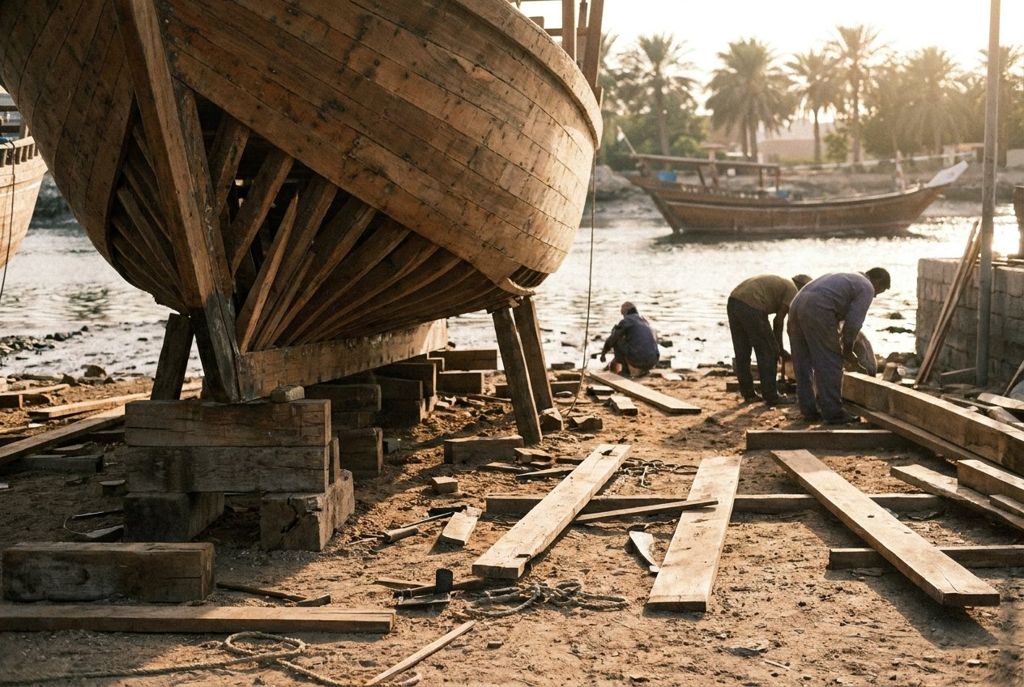
Beside the creek, craftsmen still build large wooden boats by eye and by hand, much as their predecessors did. The yard is a working place, not a museum, and visitors should treat it so.
Ajman has long been known along this coast for building dhows, the wooden sailing and motor vessels that have worked the Gulf and the Indian Ocean for centuries. The yard sits on the creek side, near the port area, and on most working days you can see hulls in various stages of construction: a bare keel on blocks, a half-planked shell, a near-finished boat waiting for its engine and paint.
The yard is a working place, not a heritage attraction, and its layout and activity change with the orders on hand. Some weeks there may be several boats on the go; other weeks, very little. That is part of what makes it worth a visit when work is happening.
How a dhow comes together
Traditional dhows in the Gulf are built without written plans. The master builder works from experience, judging the lines of the hull by eye and adjusting as the boat grows. Work usually begins with the keel, a long, heavy beam laid on blocks. The stem and sternpost are then raised at each end, and the shape of the hull is built up plank by plank and frame by frame.
Planks are steamed or soaked so they bend to the curve of the hull, then fixed with nails or bolts. Seams are caulked with cotton fibre soaked in oil to make them watertight, and the outside of the hull was traditionally coated with fish oil or a mixture of oil and lime to protect the wood. Large boats take months to finish, and the work is heavy, hot and precise.
Teak and other timber
The finest Gulf dhows were built from teak, imported from India, which is strong, resists rot and holds up well in salt water. Other hardwoods have been used for frames, keels and fittings, and today builders work with whatever suitable timber they can source. You will see stacks of long planks and heavy beams around the yard, and the smell of cut wood hangs in the air.
Wood moves as it dries and as the seasons change, which is one reason why dhow building rewards experience over drawings. A skilled builder knows how a particular plank will behave before he cuts it.
Look closely at a hull under construction and you can read the order of the work. The keel runs the full length at the bottom, the curved frames rise from it like ribs, and the planks run lengthways along the outside, each one fitted tight against its neighbour. Lighter timbers for the deck beams, rails and cabin come last, once the main shell is sound.
Another note: Pearl diving on the Gulf coast before oil
Tools old and new
Older generations of builders worked with adzes, hand saws, chisels and bow drills, the last turned with a string wound around the shaft. Power tools have largely taken over the heavy cutting and drilling, but much of the shaping and fitting is still done by hand, and the adze remains a common sight. Many of the craftsmen working on this coast today come from India, where the same family of boat-building traditions continues, and skills often pass within families.
The photograph at the top of this note was taken at a dhow yard elsewhere on the Arabian coast, not in Ajman. It shows a wooden hull of the traditional kind resting on blocks, and the boats you will see on the creek in Ajman belong to the same family: a raised, curving bow, a solid keel and a broad, deep hull.
What dhows do today
Large wooden dhows still carry cargo between Gulf ports, Iran, India, Pakistan and East Africa, and you can see them moored along creeks across the UAE, loaded with everything from tyres to electronics. Smaller boats are used for fishing. Others are built or refitted for leisure cruises, and some are built for traditional racing, which is followed keenly along the coast in the cooler months.
The boats that went out to the pearl banks a century ago were close relatives of these. The note on pearl diving before oil explains the role dhows played in that trade, and the Ajman Museum has models and parts of old vessels if you want to see the earlier types up close.
Visiting the yard
There are no formal visiting arrangements, and no ticket desk. Visitors often come and look from the edge of the yard, and many builders are happy to let you watch. Treat it as you would any building site.
- Ask before you walk in, and ask again before you photograph anyone.
- Stay clear of saws, grinders, hanging timber and any boat resting on blocks.
- Wear closed shoes; nails, splinters and offcuts lie everywhere.
- Avoid the busiest working hours if you only want to look, and do not get in anyone's way.
- Friday is the weekly day of rest for many workers, so weekday mornings are the best time to see activity.
Midday in summer is too hot to stand around in the sun. Come early, and leave when the work slows for the heat.
Around the creek
From the yard, you can follow the creek side towards the sea and the start of the long beach. The Ajman corniche is close enough to combine with a morning at the yard, and its evening crowds make a cheerful contrast to the quiet concentration of the builders. Further north, the Al Zorah mangroves offer still water and birds in place of hammers and saws.
Along the creek you will also see finished dhows tied up at the quay, some old and patched, others freshly painted. Their decks are often piled with cargo or fishing gear, and crews may be living aboard. Admire them from the quay rather than stepping onto any vessel uninvited.
On the day
- Best time: Weekday morning while work is on
- From the city: Taxi to the creek side near the port
- Bring: Closed shoes, hat, water, patience