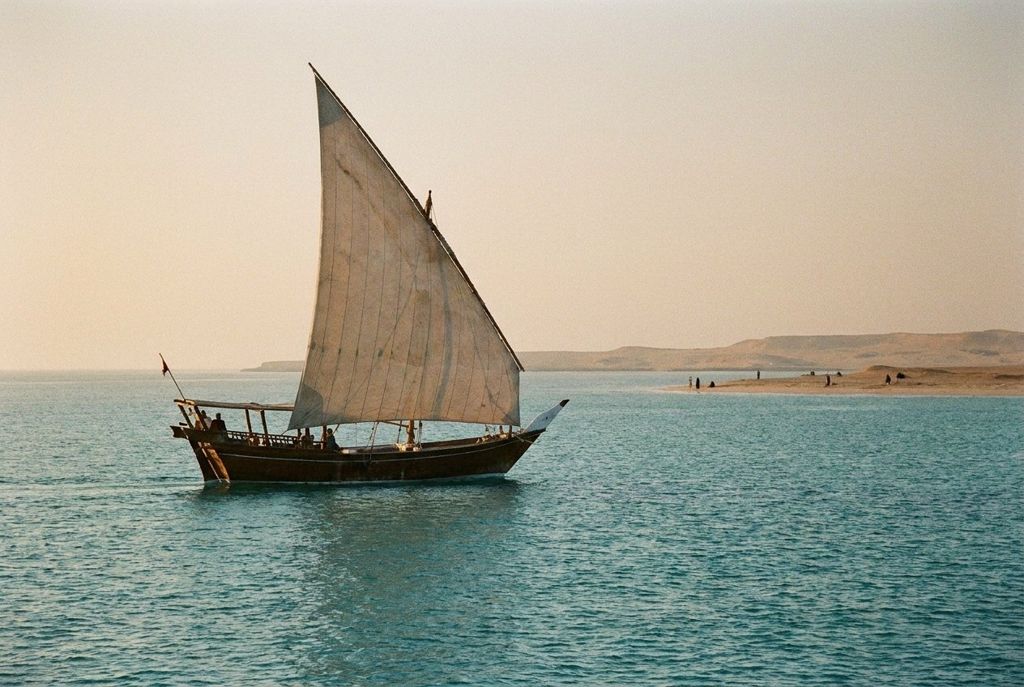
For generations, the summer pearl season decided who ate well and who fell into debt along this coast. Then, within a few years, the trade that built the towns all but vanished.
Before oil, the economy of the lower Gulf turned on the pearl banks. The shallow, warm waters off what is now the UAE held oyster beds that produced some of the finest natural pearls in the world, and towns from Kuwait to Ras Al Khaimah sent fleets out every summer to harvest them. Ajman was one of the smaller of these towns, but the same pattern ran through its life as through its neighbours': a long season at sea, months of waiting ashore, and a system of debt and credit that tied crews to captains and captains to merchants.
This note sets out how that world worked, in general terms. Exact numbers varied from town to town and year to year, and much of what is known comes from older people's memories, so treat the details here as the broad shape rather than a precise record.
The season
The main pearling season, known as the ghaus al-kabir or great dive, ran through the hottest months, roughly from early summer to early autumn. That was when the water was warm enough for men to stay in it for hours each day. Shorter seasons in cooler months worked banks close to shore, often from smaller boats, but the summer fleet was the heart of the trade.
Crews lived on board for the whole of the great dive, returning to land rarely if at all. Fresh water and dates came out to the banks by supply boat, and fish caught over the side made up much of the rest of the diet. The fleet sailed out together and returned together, and the day of return was one of the big moments of the year in every town.
Divers, pullers and the captain
Each boat carried a nakhuda, the captain, who chose the banks, kept order and dealt with the merchants. Most of the crew were divers and pullers. A diver went down with a stone weight tied to a rope to sink him quickly, wore a clip on his nose and leather guards on his fingers, and carried a small basket around his neck. On the bottom he gathered as many oysters as he could on one breath, then tugged the rope.
His puller, standing on deck, hauled him up by a second line. Pullers had to be strong and alert, because a diver's life depended on how fast he came back to the surface. A diver might go down dozens of times in a day, resting between dives by holding the rope at the surface. Oysters were piled on deck and opened the following morning, under the captain's eye, to see what the night had brought.
The work was hard and dangerous: ear damage, eye trouble, sharks, jellyfish and exhaustion were part of the job, and some men did not come home.
Another note: The Ajman Museum, inside the old fort
The dhows
Pearling crews went out in wooden dhows built on this coast and on the coasts of India and Iran. Several types were used, from larger boats carrying big crews to small craft for shallow banks. They were built of imported hardwood, often teak from India, with local labour and long inherited skills. The note on Ajman's dhow-building yard describes how boats of the same family are still built by eye along the creek.
The dhows were not only work boats. Between seasons they carried dates, timber, rice and other goods along the coasts of the Gulf, Arabia, Persia, India and East Africa, riding the seasonal winds of the Indian Ocean. A town's fleet was its wealth, and its harbour was its centre.
Debt, merchants and the shore
Few divers were free agents. Before a season, crews usually received an advance from the captain to keep their families fed while they were away, and the captain in turn borrowed from a merchant to fit out the boat. At the end of the season, the pearls were sold, the debts settled and the remainder shared out by a fixed system of portions. In a poor season, the crew could end up owing more than when they began, and debts could pass from one generation to the next.
On shore, the season left towns quiet. Women, children and older men ran households, tended palms and fished close to home. Merchants sorted and graded the pearls by size, shape, colour and lustre, using nested brass sieves and small scales, then sold them on to traders who carried them to Bombay and from there to Europe. You can see examples of these tools at the Ajman Museum.
The collapse in the 1930s
The trade fell apart quickly. In the 1920s, cultured pearls grown in Japan began to reach world markets in large numbers, at a fraction of the cost of natural ones. Then the Great Depression cut demand for luxury goods in the West. Together these blows broke the pearl market within a few years, and by the 1930s the great fleets were shrinking fast. Many men left to find work in the new oil fields elsewhere in the Gulf, while others turned to fishing or trade.
For Ajman and its neighbours, the decades between the collapse of pearling and the arrival of oil wealth were lean ones. That gap explains a lot about the way older people here remember the past, and about why the sea still matters so much in the region's sense of itself.
Where to find the story today
Pearling lives on mainly in museums, songs and festivals. In Ajman, the fort's displays are the natural starting point. Traditional rowing and sailing races held in the region in the cooler months use boats of the old types, and you may see crews practising off the coast. Walking along the Ajman corniche in the evening, with the sea flat and the lights of Sharjah and Dubai along the shore, it takes some effort to picture the summer fleets anchored offshore, but the banks are still out there, under the same shallow water.
On the day
- Best time: A cool winter morning indoors
- From the city: Ajman Museum sits near the beach
- Bring: Curiosity, comfortable shoes, water for the walk